


How to Keep a Dog From Escaping the Yard (Escape-Proof Backyard Setup Guide)


If you’re googling how to keep a dog from escaping the yard, you’re probably dealing with one of these situations:
Your dog has learned the “dig, dash, disappear” routine.
They clear a fence like it’s a warm-up jump.
They squeeze through gaps you didn’t even notice.
They’ve turned your gate latch into a puzzle they can solve faster than you.
First: you’re not a bad owner. Escaping is usually a mix of drive + opportunity. The good news is that once you understand why your dog is getting out, you can build a plan that stops it, without turning your backyard into a prison yard.
This guide walks you through the three things that actually work:
Remove the opportunity (physical upgrades)
Reduce the motivation (routine + enrichment)
Create layers of safety (backup systems)
Let’s lock it down.
Why dogs escape in the first place?
Most escape behavior falls into a handful of buckets. Identify yours first, because the fix depends on the cause.
1) Prey drive & “chase mode”
Squirrels, cats, other dogs, delivery trucks, some dogs are wired to pursue movement. Once they’ve succeeded once, escaping becomes a self-rewarding habit.
2) Boredom & under-stimulation
High-energy dogs don’t “settle” just because they’re outside. If the yard is boring, escaping becomes the day’s entertainment.
3) Anxiety (especially separation or barrier frustration)
Some dogs panic when left alone or get frustrated when they can see/hear things they can’t reach.
4) Social/sexual motivation
Dogs will go through (or under) a fence to find people, other dogs, or a mate.
5) Learned behavior
If your dog escaped once and had a great time, they’ll keep trying. Repetition creates skill.
Pro tip: A dog who escapes in the first 5–15 minutes after you leave is often anxiety-driven. A dog who escapes at random times is more often boredom, prey drive, or curiosity.
Step 1: Do an “escape audit” of your yard (10 minutes)
Before you buy anything, do a lap like your dog would.
Check these common weak spots:
Gaps under fence lines (especially corners and slopes)
Loose boards or warped pickets
Wide spacing near the gate
Low fence sections where terrain dips
Objects near the fence (woodpiles, patio furniture, planters) that become a launch platform
Gate sag that creates a “triangle gap”
Latches a dog can nose, paw, or mouth open
Now answer: is your dog escaping by digging, jumping, climbing, squeezing, or gate failure? Most yards have two vulnerabilities, not one.
Not sure if you’re dealing with digging vs jumping vs climbing? We can point you in the right direction ➡️ Click HERE
Step 2: Stop digging escapes (the #1 issue)
If your dog is tunneling under the fence, you’ll only stop the escapes by addressing two things: persistence and leverage. For mild diggers, start with quick wins, fill and tightly pack existing holes, bury large rocks or pavers where they’re targeting, and add a gravel strip along the fence line (it’s uncomfortable to dig and improves drainage).
But if you’ve got a committed digger, those are just temporary speed bumps, plan on a more permanent, “real fix” that physically blocks digging at the perimeter so your dog can’t keep gaining ground every time they try.
Option A: L-Footer dig barrier
Install a barrier that runs down a bit, then extends outward underground in an “L” shape.
Dogs start digging at the fence line; they hit the barrier and give up.
Option B: Buried wire/mesh barrier
Lay heavy-gauge wire/mesh along the perimeter.
Anchor it well and cover with soil/gravel.
Option C: Concrete curb/edge
A hard barrier prevents tunneling.
Great for high-drive dogs who return to the same spot repeatedly.
Bonus: fix the “favorite digging zone”
Dogs often dig where the ground is cooler, softer, or where scents collect. Add:
Shade (to reduce digging for cool ground)
A dedicated dig pit (yes, really, give them an approved spot)
More structure to their outdoor time (see enrichment section)
Want an easier-to-clean setup (and less mess around the perimeter)? See flooring kits ➡️ Click HERE
Step 3: Stop jumping escapes (height + launch points)
If your dog is jumping the fence, it comes down to two things: barrier height and launch points. Move anything climbable at least 3-5 feet from the fence, patio furniture, stacked lumber, storage bins, planters, even AC units, since small step-ups can turn a jumper into an escape artist. Then boost height strategically by adding extensions where your dog targets and reinforcing low spots on slopes. If outside triggers are fueling the behavior, a visual barrier can reduce fence-fixation and cut jump attempts.
Many dogs jump because they see triggers outside the yard. Adding privacy panels or reducing see-through gaps can help a ton, especially for barrier frustration.
Step 4: Stop climbing escapes (climbers are different)
Climbing dogs aren’t “jumping higher”, they’re using paws, wire, or boards like a ladder. To stop it, avoid climb-friendly materials when possible (some wire designs act like rungs), add smooth barrier sections along the inside near the top so they can’t get traction, and consider roller toppers that spin when a dog tries to grab the edge. The goal is to eliminate the “grip” points that make climbing possible.
If your dog can hook their toes into something, they can climb. The fix is reducing grip surfaces near the top edge and reinforcing corners (corner posts are climber highways).
Step 5: Stop squeeze-through escapes (gaps you didn’t know existed)
This kind of squeeze-through escape is super common with young dogs and athletic adults, so do a quick perimeter check in the usual trouble spots: gate corners, fence-to-house connection points, under the gate where sag creates space, and anywhere pickets have spread over time. To fix it, add kick boards or bottom boards where gaps form, reinforce gates with anti-sag hardware to keep everything aligned, and tighten spacing around gate edges using trim or added framing.
If you can fit a dog’s head through a gap, you may soon fit the whole dog.
Step 6: Gate and latch security (the silent failure point)
You can have a great fence and still lose the war at the gate. Escaping through a gate is usually caused by:
Latch design that’s easy to paw open
Misalignment from sagging
Family members not fully closing it
Make your gate harder to “mess up” by using a self-closing hinge when possible, installing a two-step latch that takes two actions to open, and adding a secondary lock or carabiner as backup. Then check for gate sag monthly and adjust it so gaps don’t slowly reappear.
Think “layered safety.” One latch fails, the backup keeps your dog safe.
Step 7: The best “escape-proof” setup is layered containment
If you have a strong, driven, or anxious dog, don’t rely on a single barrier.
Smart layering ideas
Double-gate entry (a small “airlock” area so if one gate opens, your dog still can’t bolt).
Dedicated secure outdoor zone attached to your home.
Reinforced panels + roof cover for high climbers (especially if left outside unsupervised)
Layering is the difference between “mostly secure” and “my dog can’t outsmart this.”
Want a step-by-step plan for a double-entry or reinforced setup? Explore DIY Guides & Build Help ➡️ Click HERE
Step 8: Reduce the motivation to escape (this matters more than people admit)
Even the best setup gets tested if your dog’s needs aren’t met. Reduce escape attempts with more structure: real exercise beyond “yard time,” food enrichment (scatter feeding or puzzle bowls), obedience or scent “job” games, and calm reps so your dog relaxes outside instead of pacing the fence, especially for anxiety-driven escapers.
Start with short, successful sessions and gradually build duration as your dog improves. If your dog panics, destroys things, or injures themselves trying to get out, consider working with a trainer to address the underlying stress and keep everyone safe.
Step 9: Common mistakes that make escaping worse
🐶 Mistake 1: “He’ll grow out of it.”
Escaping is self-rewarding. Dogs usually get better at it with practice.
🐶 Mistake 2: Punishing after the fact
Your dog won’t connect punishment with the escape that happened 30 minutes ago. You’ll only teach them to avoid you when caught.
🐶 Mistake 3: Adding a quick fix to the wrong problem
A taller fence won’t stop digging. A dig barrier won’t stop climbing. Identify the method first.
🐶 Mistake 4: Leaving tempting triggers unmanaged
If your dog escapes to chase the neighbor’s cat every day at 4 p.m., you need a plan for that window of time-training + management + physical upgrades.
Quick checklist: Escape-proof backyard plan
Digging
Barrier (L-footer, mesh, curb)
Reinforced corners and slopes
Cool/shade options to reduce digging motivation
Jumping
Remove launch points
Add height where needed
Add visual barrier if triggers are outside
Climbing
Reduce grip surfaces
Reinforce corners
Consider roller toppers / smooth barrier sections
Squeezing
Fix gate alignment + sag
Close gaps at fence connections
Add bottom boards where spacing changes
Gate security
Two-step latch
Secondary lock
Self-closing hinge (if possible)
Behavior
Daily exercise plan
Enrichment routine
Training support if anxiety-driven
FAQ: How to keep a dog from escaping the yard
How tall should a fence be to stop a dog from jumping?
It depends on the dog’s athleticism and motivation. Many dogs can clear surprisingly high barriers if they’re determined, especially if there are launch points or strong triggers. Height helps, but removing launch points and reducing triggers is just as important.
What’s the best way to stop a dog from digging under a fence?
A physical barrier is the most reliable: an L-shaped dig barrier, buried mesh, or a hard curb. Then reduce the motivation (shade, enrichment, routine).
Why does my dog only escape when I’m gone?
That often points to anxiety or boredom. Tighten the physical weak spots, but also change the pattern: shorter alone sessions, more structure, and training support if needed.
Are roller toppers worth it?
For climbers, yes, they can be a game changer. But they won’t solve digging or gate issues.
Build for your dog, not an “average dog”
Some dogs need basic reinforcement. Others need a serious, layered setup with dig barriers, anti-climb solutions, and gate redundancy.
If you want help planning a secure outdoor setup that fits your dog’s size, drive, and habits, HustleLine Kennels can help you think through a layout that’s safer, easier to clean, and harder to outsmart, without you having to reinvent the wheel.
Quick Links to Help You Lock It Down.
PREMIUM OUTDOOR KENNELS
Modular Decks & Roof Systems: Upgrade Your Existing Kennel with HustleLine-Grade Components.
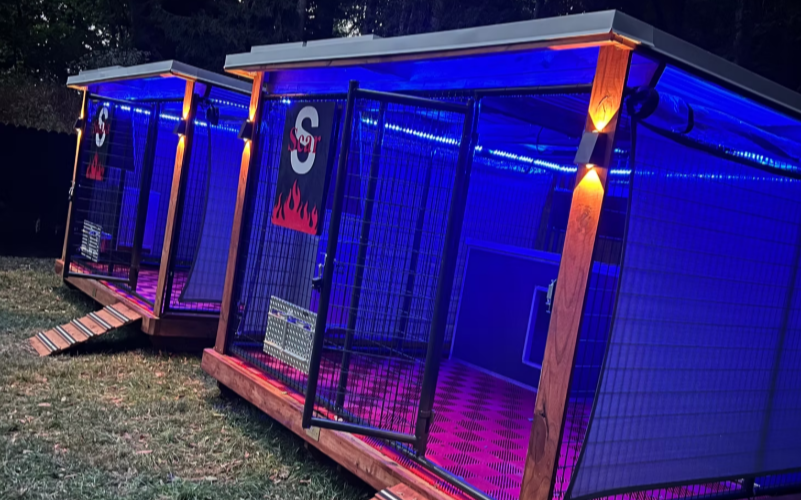
THE BIG DOG FLOORING BUNDLE
Step-by-step layout, structural planning, and drainage setup guidance to build a durable 10×10 kennel.

ITEMS WE SUGGEST
Elevate your kennel setup with our handpicked essentials. Discover the top items we recommend!


Comments